
The latest US jobless report shows a drop in the insured unemployment rate alongside a sharp rise in new benefit claims. The mixed result illustrates a labour market that remains tight by global standards, but not immune to late-year volatility.
Insured Unemployment Rate Change
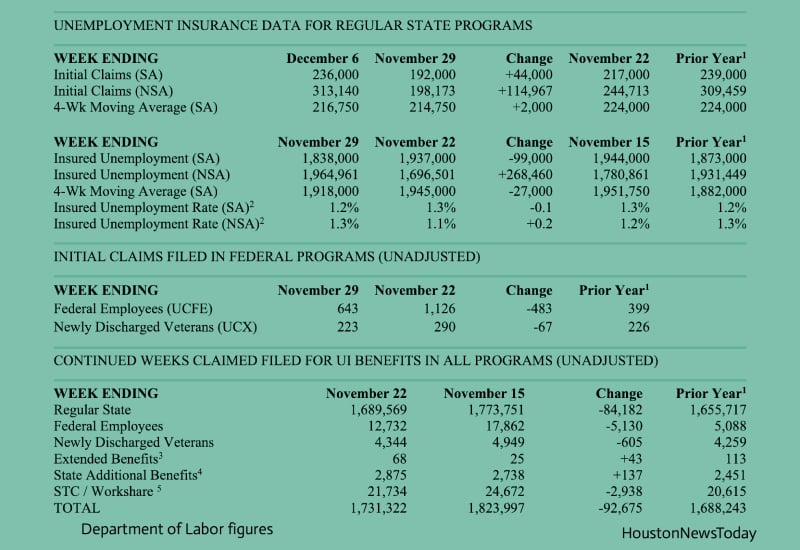
For the week ending Nov. 29, the seasonally adjusted insured unemployment rate fell to 1.2 percent from 1.3 percent the previous week. Seasonally adjusted continuing claims declined to 1,838,000, a decrease of 99,000. That figure stood close to levels recorded at the end of 2024, when the insured unemployment rate also stood near 1.2 percent. [ DOL (PDF) ]
At the same time, the week ending Dec. 6 brought a jump in new filings. Seasonally adjusted initial claims rose to 236,000, up 44,000 from the prior week’s revised 192,000. The four-week average edged up to 216,750, but remained below mid-year peaks.
Initial State Claims
On an unadjusted basis, initial state claims totaled 313,140, up 114,967 in a single week. Seasonal factors anticipated an increase of 56,785, underlining the strength of this move. Yet the total number of continued weeks claimed across all programs fell to 1,731,322 in the week ending Nov. 22, down from 1,823,997.
International observers often track the insured unemployment rate as one benchmark for labour market tightness. The latest reading of 1.2 percent sits below levels seen in many advanced economies, even after a long period of global uncertainty.
States with the highest insured unemployment rates in the week ending Nov. 22 included New Jersey and Washington at 2.2 percent. Massachusetts, Alaska, Connecticut, Nevada, Puerto Rico, Rhode Island, California and Oregon followed closely. These regional differences underscore the uneven impact of national economic trends.
Technical notes in the release stress that weekly claims reflect administrative data and show strong seasonal swings. Fluctuations around holidays, school schedules and weather events can lift initial claims even when the insured unemployment rate remains low. NewsBlaze reported a 58 percent jump in weekly jobless claims.
As reported in August 2025, Generative AI is shaking up how companies plan and invest in digital tools. It started with small steps and as it leads to major breakthroughs, it affects employment.
The insured unemployment rate will remain a key indicator for global investors, central banks and multinational employers watching the balance between US labour demand and economic growth.

